The state has raised the recognised cost ceilings for restoration, promises faster permits and a single service centre for owners. What that changes for anyone holding an old stone house — and what happens inside the walls when the façade cannot be touched.
Three stories from this summer, seemingly unconnected.
The old municipal market inside the walls of Nicosia — a building that stood half-empty for decades — is now the Cyens research centre. In July the project was named among the twenty-five best European social cohesion projects of 2026; the investment came to roughly €7.8 million.
In the village of Limnia in the Famagusta district, restoration was completed on a stone house whose earliest parts date to the late 18th century and which was declared an ancient monument back in 1971. The works covered masonry, roof, timber elements, floors and the courtyard.
And somewhere in the Troodos another house with an arch and a pomegranate tree in the yard opened as a guesthouse. There are already more than a hundred of those on the island, across some sixty villages.
Architecturally they have little in common. What they share is the moment: restoration in Cyprus has started to count again.
What actually changed
The Council of Ministers approved new ceilings on the expenditure the state recognises when it supports the restoration of listed buildings. For properties up to 300 m² the ceiling rose from €1,400 to €1,700 per square metre. For buildings between 301 and 1,000 m², from €1,300 to €1,600. For anything above a thousand square metres, from €1,000 to €1,300 per square metre.
The reasoning is simple and, unusually, stated plainly: materials and labour rose by roughly a quarter, the recognised amounts did not keep up, and owners simply postponed restoration — the gap between a real budget and what the state would recognise had grown too wide.
The money, though, is not the most interesting part. In parallel, a fast-track permit procedure for listed buildings is being prepared, exempting certain low-risk works from a full building permit is under discussion, a single digital register of listed properties is being created, and a one-stop centre is planned where an owner can obtain every approval and consultation in one place. Along with regional offices and a detailed restoration guide — for owners, architects, engineers and the supervising authorities themselves.
Historic Nicosia is its own storyline: a €28 million plan presented in February covers streets, parking and infrastructure across the old town.
For the owner of an old house all of this adds up to one sentence: the friction went down. And friction — not the cost of the tiles — is usually the reason a house stands boarded up for twenty years.
The outside is off limits — so everything moves inside
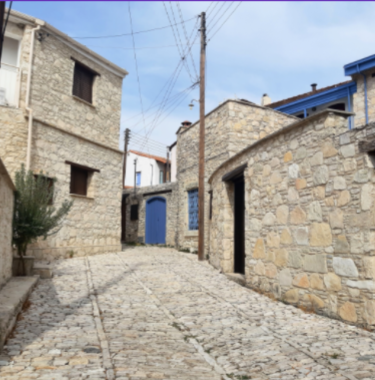
Restoration has one hard rule, and it is the rule that makes it restoration: the external envelope is untouchable. The masonry, the silhouette, the proportions of the openings, the arches, the cornices — that is precisely what is being protected. No external insulation on the façade.
Which means that everything determining what the house is actually like to live in — the temperature in July, the bill in January, dry corners, quiet — is resolved from the inside. This is not a compromise. For a listed building, internal insulation is the only correct route, and in Europe it has been refined over decades.
The Cypriot context is fairly unforgiving. More than half the buildings on the island went up before 2000, that is, before meaningful energy performance requirements. Cooling demand in Cyprus runs roughly six times the European average. Electricity costs around €0.32 per kilowatt-hour. And summer humidity on the coast sits at 60–70%. A beautiful stone house with no interior work stays a beautiful stone house — one that is stifling in summer and cold in winter.
A stone wall does not live like a concrete one
This is where things most often go wrong — and they go wrong not immediately but two or three years later, long after the crew has left.
Old masonry laid in lime mortar is an open system. It takes moisture in and gives it back: outward through the façade, inward through the plaster, seasonally and cyclically. It has worked that way for two hundred years, and that is the only reason it has stood for two hundred years. There are salts in the masonry, there is capillary rise from the ground, there is driving rain in winter.
Here is what happens when such a wall is sealed from the inside with expanded polystyrene: moisture loses its route out. It does not disappear — it accumulates in the masonry and at the contact zone. Then the familiar sequence follows: damp at floor level, blistering plaster, white salt bloom, smell. Cement plaster, incidentally, does exactly the same thing, only more slowly.
Mineral wool in this situation is technically non-combustible, but it requires a vapour barrier — that is, it deliberately turns a breathing wall into a sealed one. It is also vulnerable to getting wet: once it takes on moisture it loses thermal performance and eventually slumps.
A stone wall needs a material that does not argue with its physics. Mineral, vapour-open, and able to move moisture rather than trap it.
What that means in numbers
MULTIPOR is a mineral insulation board from the aerated concrete family: sand, lime, cement, water. No fibres, no synthetics. Its vapour diffusion resistance factor μ is 3 — resistance is practically negligible and the wall keeps breathing. Thermal conductivity is 0.045 W/(m·K) and density around 115 kg/m³, meaning the insulation layer adds mass to the wall and works together with the thermal inertia of the stone itself rather than against it.
The defining property is capillary activity: the board actively transports moisture from a zone of high humidity towards a zone of low humidity. In the wall, that means moisture does not stagnate in one spot; inside the room, the board acts as a humidity buffer, absorbing excess and releasing it back once the air dries out. For a house heated intermittently in winter and shut up for a month in summer, that is not a detail.
And reaction to fire class A1. In an old Cypriot house the floors and roof structure are timber — here what matters is that the insulation layer adds not a gram of fuel and releases no toxic smoke. The material carries CE marking and natureplus certification, and production has been climate-neutral since 2022 — for a project presented as cultural or ecological, that is a line worth putting in the description.
| What matters for old masonry | Polystyrene (EPS) | Mineral wool | MULTIPOR |
|---|---|---|---|
| Vapour resistance μ | 30–70 — a barrier | Low, but needs a membrane | 3 — the wall breathes |
| Moving moisture out | Traps it | Neutral, accumulates it | Transports it capillary-wise |
| If it gets wet | Moisture stays in the wall | Loses performance, slumps | Releases moisture, recovers |
| Reaction to fire | E — burns, toxic smoke | Non-combustible | A1 — non-combustible |
| Compatibility with lime | A foreign layer | Needs framing and film | Mineral onto mineral |
| Service life | Degrades | Depends on moisture | Matches the building's |
An old wall gets prepared — and that preparation is ordinary restoration work
One honest caveat: the board does not go onto century-old masonry as it stands. The substrate needs preparation. The good news is that almost everything on the list below happens in a restoration anyway — insulation does not add a separate stage, it slots into one already in the budget.
- Strip the foreign layers. Loose and cement-based plaster comes off — cement harms old masonry regardless of what follows. The substrate stays mineral, sound and dust-free.
- Bring it to a plane. 18th-century masonry is not flat, and that is normal. A mineral levelling layer gives an even base for the adhesive, and it is usually already part of the restoration works.
- Deal with moisture from below. Capillary rise is treated with a damp-proof course and work at the base. Without it, any material will be working over a wet wall — the only question is how quickly it shows.
- Detail the timber and metal junctions. The board is bonded to a mineral substrate and is not fixed to timber or steel. So beam ends, roof junctions and old metal ties get their own ventilated solution. In a restoration those junctions are opened up and inspected in any case.
- Keep the finish mineral. Lime plasters and lime paints continue the same logic. A house that breathes is not sealed with acrylic paint.
A typical scenario
A village house of about 90 m², walls of local stone close to half a metre thick, timber floors, tiled roof, a courtyard with a well. The owner wants to live there and let it as a guesthouse for part of the year.
At 2026 market benchmarks, a full restoration on that scale means roughly €110,000–200,000 of works on top of the purchase price. Internal insulation takes a small share of that budget. Yet it is precisely what decides how the house feels in July, when it is pushing forty outside, and in January, when it is five degrees and damp in the hills.
After that, the arithmetic becomes hospitality arithmetic. Guests remember the arch and the pomegranate tree, but they come back — and leave the review — because the bedroom was not stuffy, there was no smell of damp, and the air conditioning was not running around the clock. At around €0.32 per kilowatt-hour and Cypriot cooling demand, cooling is the main operating cost line for a house like this.
What to do with all this now
The window is genuinely good, and it is not permanent: ceilings are up, procedures are promised to speed up, the one-stop centre is only being set up. One detail worth confirming in advance: support for the full restoration of a property is, as a rule, granted once, and again only after many years. Redoing the work at your own expense five years later is both expensive and galling.
Hence the practical conclusion: decisions about the walls are not taken at the end, "once we get to the finishes", but at design stage — alongside the roof, the base and the services. Internal insulation in a listed building is not a decorating option, it is part of the technical solution.
The business takeaway
For a private owner: you buy an old house for its character, but you live in it on its physics. The character is protected by law — the physics you have to sort out yourself, from the inside, and preferably once.
For developers and agrotourism: a restored listed building has a rare property — it cannot be built from scratch. But the premium price rests on an impression, and an impression breaks on one damp corner faster than on any design decision.
For designers: in old masonry the winner is not the material with the best lambda, but the one that does not argue with the wall's existing physics. Mineral onto mineral, vapour-open onto vapour-open, A1 where there is timber nearby.
Sources: Council of Ministers decision and Ministry of Interior briefing (via inbusinessnews and DOM Live reporting, 2026), Cyprus Mail (Limnia house restoration, July 2026; Cyens project, July 2026; historic Nicosia plan, February 2026), index.cy (restoration cost benchmarks, 2026), manufacturer technical data from Xella / MULTIPOR. Information on grants and incentives is indicative — confirm conditions with the Ministry of Interior and the Department of Town Planning and Housing.