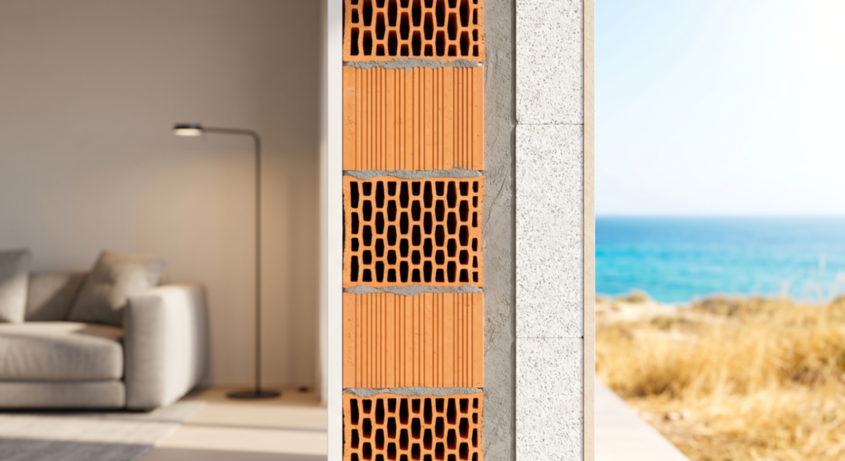
Check Your Wall’s Real U-Value: Does your home meet Cyprus standards?
A simple tool to estimate real heat loss based on surface temperatures
Thermal Performance Standards
This tool is based on international standards ISO 6946 (calculation methods) and ISO 9869-1 (in-situ measurements of thermal resistance). In Cyprus, current national energy performance regulations require wall U-values to be ≤ 0.4 W/(m²·K) for new buildings or major renovations.
Disclaimer: The results provided by this calculator are for informational purposes only and represent an estimate based on your manual inputs. They do not substitute an official energy audit or building energy performance certificate.
For a detailed building fabric analysis or to obtain an official Energy Performance Certificate (EPC), you must consult a certified energy auditor or structural engineer.
Comprehensive Measurement Guide
To achieve accurate and reliable U-value estimates, strict adherence to measurement protocols is required. Follow these guidelines based on building physics best practices:
Optimal Timing & Thermal Equilibrium:
Take measurements 30–60 minutes before sunrise. During this window, the building envelope has cooled down from the previous day's solar radiation, and thermal conditions are most stable. Avoid taking measurements during or immediately after heavy rain, strong winds, or sudden temperature changes.
Required Temperature Difference (ΔT):
For the calculations to be mathematically and physically meaningful, there must be a sufficient temperature gradient between indoors and outdoors. A minimum difference of 5–10 °C is highly recommended. If indoor and outdoor temperatures are nearly identical, the heat flow approaches zero, rendering the calculation invalid.
Sensor Placement & Thermal Bridges:
Choose a flat, uniform section of the wall. Avoid measuring near corners, windows, doors, load-bearing columns, electrical outlets, or directly behind radiators. A safe distance for measurements is at least 1.5 times the wall thickness (typically 1 to 1.5 meters) away from any geometrical edge or potential thermal bridge.
Using Infrared (IR) Thermometers:Infrared (IR) thermometers or thermal cameras are perfectly suitable for measuring surface temperatures. Ensure the device's emissivity setting is correct (for most paints, plasters, and brickwork it is 0.93–0.95). Hold the device perpendicular to the wall at a short distance. Take 3–5 readings around the target spot and average the result.
Measuring Air Temperature:
Do not measure air temperature too close to the wall, as boundary layers can distort the readings. Measure indoor air temperature near the center of the room, at a height of about 1.5 meters, away from direct heat sources. Measure outdoor air in a shaded, well-ventilated area, away from direct sunlight and exhaust vents.
Data Entry & Precision:
Enter all data into the calculator with a precision of one decimal place (e.g., 21.0 °C). Even a 0.2 °C deviation can significantly impact the final U-value.

 English
 Ελληνικά
 Русский
 עִברִית