Energy vs. moisture: what a review of 120+ scientific studies shows — and what it means for Cyprus
Building physics moves faster than market habits. Many solutions that were taken for granted ten years ago are now being revisited in scientific journals — on the basis of years of field measurements, not brochures. That is why we regularly read new research on thermal insulation, moisture and indoor climate, and check what really matters for the Cypriot climate and Cypriot homes.
With this article we launch our “Science & Research” section. The format is simple: we take one scientific paper, summarise it briefly and honestly, separate the authors’ conclusions from our own — and show what follows for anyone building or insulating a home in Cyprus.
Part 1About the study
- Authors
- Muhammad Kashif, Saif Ul Haq, Musaddaq Azeem, Hafiz Muhammad Asad Ali
- Affiliations
- De Montfort University, Leicester, UK; Green Energy and EPC Services Ltd — a UK building energy certification company
- Journal
- Sustainability (MDPI), peer-reviewed, 2026, Vol. 18, Issue 6, article 2950
- Published
- 17 March 2026, open access (CC BY)
- Type of work
- Systematic review of more than 120 peer-reviewed studies from 1994–2026 (Scopus and Google Scholar), across different climate zones
- DOI
- 10.3390/su18062950
It is important to understand the genre. This is not an experiment but a review: the authors collected and compared the results of more than a hundred other studies — laboratory tests, computer modelling and long-term field observations of real buildings. The value of this format is that it shows not a single result, but the overall picture that has emerged in science.
The main idea of the review fits into one formula the authors call the “energy–moisture dilemma”. Insulation, airtightness and modern windows really do cut energy use. But if the movement of moisture in the walls is ignored, an “energy-efficient” building can become damp, start deteriorating from the inside — and harm the health of the people who live in it.
What matters for construction in Cyprus
Moisture travels three ways — and the most important one gets the least attention
The authors examine three mechanisms of moisture transport in walls: water-vapour diffusion, capillary transport of liquid water, and moisture carried by air through gaps. It is the combination of all three that decides whether a wall stays dry. A telling observation of the review: most of the scientific literature deals with vapour and condensation, while capillary transport of liquid water receives far less attention — even though it is responsible, for example, for rising damp from the ground.
In practice this means something simple: the vapour permeability figure on a certificate is only part of the picture. Vapour means grams of moisture per cubic metre of air; liquid water in masonry means kilograms per cubic metre of wall. To keep a wall dry, a material has to be able to deal with liquid water.
The 60% threshold — and a Cypriot coast where the outdoor air itself exceeds it in summer
The review links mould growth to relative humidity above 60% and recommends keeping indoor humidity at 40–60%. For Limassol, Larnaca and Paphos this is not abstract: in summer, outdoor humidity on the coast is 60–70%, and in winter, during the rainy season, walls are regularly wetted from outside. Cyprus is a case where moisture enters the wall from both the inside and the outside.
Health is not a side topic but an equal criterion
A significant part of the review is devoted to how dampness affects people. The authors cite WHO data: dampness and mould in homes increase the risk of asthma by up to 50%. According to the review’s summary data, people living in damp homes have a 30–50% higher risk of respiratory disease, and in children the risk of respiratory infections and cough rises by 30–70%. Children, older people and those with weakened immunity are especially vulnerable. The authors’ conclusion: occupant health should be as much a criterion of an insulation project as energy savings.
The same “correct” detail behaves differently in different climates
The authors stress that there is no universal solution. In cold regions the main threat is condensation inside the wall in winter; in hot and humid ones it is high indoor humidity, where ventilation and dehumidification come to the fore. In one of the cases reviewed, the same wall build-up behaved differently in two cities of the same country. Cyprus combines both regimes: a hot, humid summer with air conditioning running, and a mild, wet winter — so solutions copied “as is” from northern Europe do not work here the way they were designed to.
Problems do not appear immediately
Another important observation: many insulation failures are “latent” and appear only after several seasons — once moisture has accumulated behind the insulation or the material has started to lose its properties. The authors therefore advise judging an insulation project not by its first winter, but by monitoring wall and indoor humidity for at least 1–2 full seasons.
Cyprus is a blank spot on the research map
The authors openly name a limitation of their own work: research is concentrated in Europe, North America and Africa, while practical case studies from Asia and the Middle East are lacking. The Eastern Mediterranean, with its combination of heat, sea humidity and mild winters, is poorly studied. This makes field experience — observations of real buildings in the real climate — especially valuable for Cyprus.
Part 3Replacing fibrous insulation with MULTIPOR: what it gives
Let us draw the line straight away. The review does not mention any brands. It talks about classes of materials — and this is where our conclusion begins, not the authors’.
What the review says about fibrous insulation
The authors note that glass wool and mineral wool lose much of their thermal performance when damp, and that wet insulation becomes a breeding ground for mould, fungi and bacteria. According to the review, moisture in insulation can increase heat loss by up to 12%.
What the review says about capillary-active insulation
A Belgian study discussed in the review compared two approaches: insulation with a vapour barrier and capillary-active insulation. The vapour-barrier system gave a small thermal gain, but in some cases raised moisture levels in the wall and mould risk. The capillary-active system handled moisture better: moisture levels in the wall stayed almost the same as in the wall before insulation. In other words, insulating did not add moisture to the structure. In the section on lessons from failed projects, the authors conclude that rather than focusing on thermal resistance alone, it is essential to choose capillary-active materials that let moisture leave the structure.
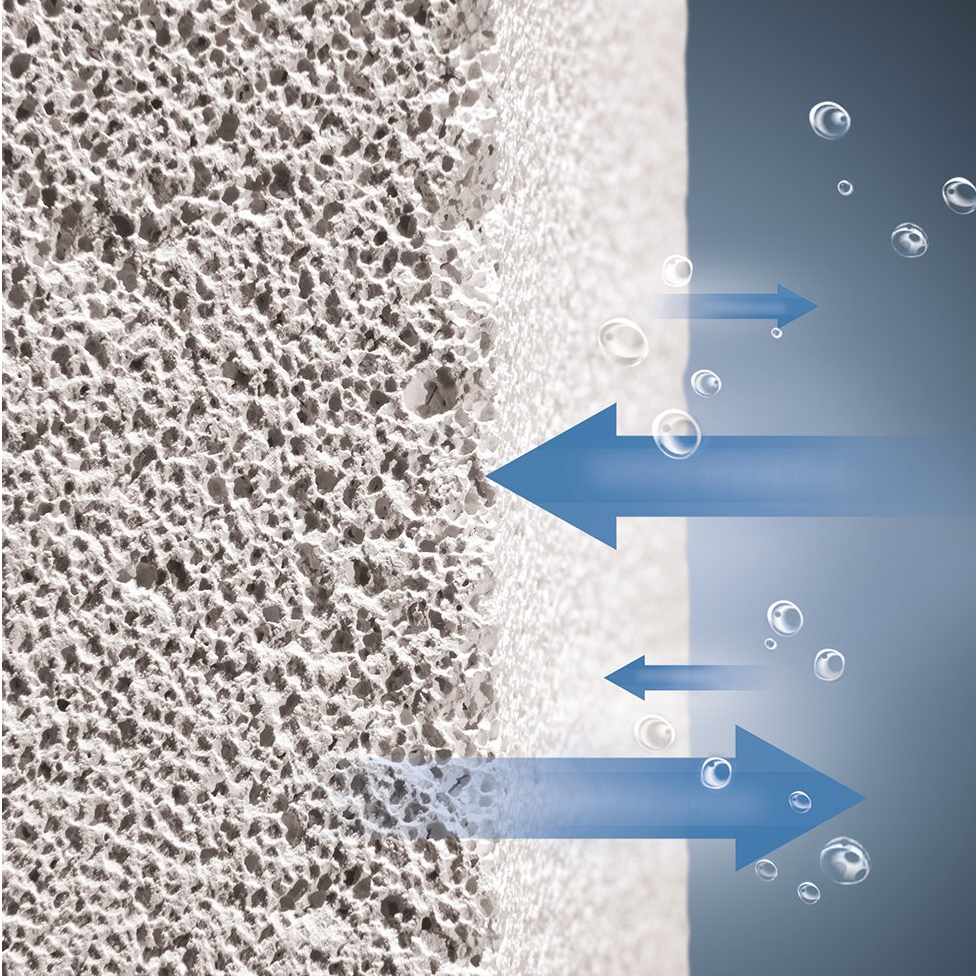
MULTIPOR belongs to exactly this class. It is a mineral board made of sand, lime and cement with a network of interconnected capillaries. Its vapour permeability is close to that of wool (μ = 3), but unlike wool it can move liquid water — from a damp wall to the outer surface, where the water evaporates.
Datasheet vs. real use: where the savings come from
When dry, mineral wool conducts heat slightly less than MULTIPOR (λ of about 0.035–0.040 vs. 0.045 W/(m·K)) — and looks better on paper. But the declared value is measured on a dry sample, while insulation works in a real wall. The real question is what thermal conductivity it has on average over a year.
A revealing study by the Aristotle University of Thessaloniki, carried out together with a Greek stone wool manufacturer, found that after prolonged wetting stone wool practically stops working as insulation — its thermal conductivity approaches that of clay brick. The good news from the same work: if stone wool is allowed to dry out, its properties return almost completely.
The key word is “if”. In northern countries, dry frosty winter air draws moisture out of the wool. The Cypriot winter is too mild and humid for that, and north-facing façades get almost no sun. In our field observations, wool in such walls stays damp for much of the winter — and works with a thermal conductivity noticeably worse than declared.
How much worse? Estimates vary:
- +12–14% in thermal conductivity — in real structures: glass wool after 25 years in masonry (binder and water-repellent treatment degraded) and attic glass wool after a single heating season;
- up to 40% loss of thermal resistance — for stone wool on a trafficable roof;
- 1.7 to 3 times higher thermal conductivity — under heavy wetting in laboratory tests.
For hot and humid climates there is also a direct estimate of the consequences. A study by the same De Montfort University (Sustainability, 2023) showed that ageing of building components can raise cooling energy use by 9.5–38% over 25 years, with degradation of wall insulation having a greater effect than other factors. Insulation that keeps its properties saves more over its service life than insulation with a better number on the datasheet.
Binder, heat and mechanics
The fibres of mineral wool are held together by an organic binder. Traditionally this is phenol-formaldehyde resin; some manufacturers now use newer formaldehyde-free formulations. Either way, it is organic — and it is what makes the board a board. And it is exactly what suffers from the combination of moisture and high temperature that a Cypriot façade sees every day.
- only ~7% of strength left: stone wool removed from a roof after ~10 years in a humid environment with surface temperatures up to 70 °C had a compressive strength of about 5 kPa instead of the declared 70; the phenol-formaldehyde binder was partly degraded (University of Maribor, Materials, 2020);
- significant weakening and higher water retention in wool aged in moisture at 65 °C — while a rendered façade can heat up to 70 °C (Tallinn University of Technology, 2025);
- loss of almost half its strength and about 20% of its density — wool in rendered façade systems, due to binder breakdown (Brest State Technical University);
- loss of up to 70% of tensile strength and up to 20% of compressive strength — mineral wool boards after accelerated climatic ageing (Slovenian National Building and Civil Engineering Institute).
| Parameter | Typical façade wool | MULTIPOR |
|---|---|---|
| Compressive strength | ~10–15 kPa | over 300 kPa |
| Bending strength | ~10 kPa | ~80 kPa |
| Bond (pull-off) strength | from ~10 kPa | from 80 kPa |
| Binder | organic, ages with moisture and heat | none — mineral matrix (sand, lime, cement) |
| Vapour resistance μ | 1–3 | 3 |
| Liquid water transport | practically none — water is held on the fibres | yes — capillary activity |
An order-of-magnitude difference in strength is not a number for its own sake. A soft layer settles and compacts over time, especially when it is damp and heavier: voids form at the top, waterlogged zones at the bottom, and in places the board pulls away from the wall. Air starts to circulate in these gaps, and heat bypasses the insulation. A rigid mineral board keeps its shape and close contact with the wall throughout its service life — and with it, its design thermal performance.
In Larnaca, a separate apartment was built on top of an existing house using a steel frame with plasterboard inside; in Souni, an extension was built with the same technology. In both projects, MULTIPOR was used on the outside instead of mineral wool (in Souni on both the walls and the roof): the aim was to protect from moisture not only the main house but also the moisture-sensitive plasterboard.
How to get the most from capillary-active insulation
The authors of the review rightly note that any material, including a capillary-active one, only works properly within a properly designed system. That is why we treat the following steps as an essential part of the job, not as extras:
- Assess the wall before insulating: leaks, rising damp, cracks, salt contamination.
- Eliminate sources of moisture: drain water away from the plinth, restore waterproofing, repair gutters and downpipes.
- Use the system’s vapour-open adhesive and finishing layers — no membranes and no “sealing” paints.
- Provide room ventilation: extraction in the kitchen and bathroom, and with airtight windows, mechanical ventilation with heat recovery.
- Keep indoor humidity within 40–60%: an inexpensive hygrometer shows it at all times.
- For the first 1–2 seasons after insulating, keep an eye on corners, window reveals and slab junctions.
Capillary activity is a conversation about litres — thousands of grams of liquid water that the material draws out of the masonry and brings to the outer surface, where it evaporates. This flow has only one direction: from wet to dry, out of the wall.
Grams versus litres — a thousand-fold difference. That is why, for dry walls and healthy indoor air, capillary activity matters by orders of magnitude more than vapour permeability. Insulation for the Cypriot climate should be chosen on the physics of the process, not on one line of a datasheet.
Conclusion
- Science is shifting its focus from “how much energy was saved” to “how much energy was saved without harming the building and its occupants”. Occupant health is becoming a full criterion of a project.
- This is especially relevant for Cyprus: moisture enters walls both from outside and from inside, and the mild winter does not let fibrous insulation dry out.
- Capillary-active insulation, the class MULTIPOR belongs to, handles moisture better in practice — and keeps thermal performance closer to design values year after year.
- For developers this means fewer complaints about damp and mould and stable performance they can stand behind with buyers. For homeowners — dry walls, healthy air and electricity bills that do not grow as the insulation ages.
- Kashif M., Ul Haq S., Azeem M., Ali H.M.A. Hygrothermal and Climatic Energy Retrofit Strategies for Net-Zero Buildings: Performance Impacts and Occupant Health. Sustainability 2026, 18(6), 2950. doi.org/10.3390/su18062950
- Karamanos A., Papadopoulos A.M., Aravantinos D., Chadiarakou S. The impact of moisture on the thermal conductivity value of stone wool based insulating materials. PALENC 2007, Crete.
- Künzel H.M. Long-Term Thermal Performance of Insulations Under Moisture Loads. In: Thermal Insulation and Radiation Control Technologies for Buildings. Springer, 2022.
- Taki A., Zakharanka A. The Impact of Degradation on a Building’s Energy Performance in Hot-Humid Climates. Sustainability 2023, 15, 1145.
- Study of the degradation of stone wool from a flat roof (with a review of field data on glass wool). J. Therm. Anal. Calorim., 2019. doi.org/10.1007/s10973-019-08384-5
- Ivanič A. et al. The Influences of Moisture on the Mechanical, Morphological and Thermogravimetric Properties of Mineral Wool Made from Basalt Glass Fibers. Materials 2020, 13, 2392.
- Olak H., Kalamees T. et al. Degradation of mineral wool: the effect of elevated temperature and moisture content on the hygrothermal properties. ICMB25, UCL Open Environment, 2025.
- Comparative Experimental Analysis of Wet-State Thermal Performance in Pipe Mineral Wool Insulation. Energies 2025, 18, 6074; Marmoret L. et al. J. Building Physics, 2016.
- Ducman V. et al. The influence of accelerated ageing on the mechanical properties of mineral-wool boards, 1998; Chernoivan V.N., Chernoivan N.V. Evaluation of the influence of atmospheric impacts on the strength and elastic properties of mineral wool boards, BrSTU.
- Xella MULTIPOR technical data; Multipor-Cyprus field observations (since 2016, 400+ projects).